
Suffering: A Mystery to Be Lived
The poor one cried out and the LORD heard, and from all his distress he saved him. (Psalm 34:7)
We must no longer be children, tossed and blown about by every wind of doctrine, by people’s trickery, by their craftiness and deceitful scheming. But speaking the truth in love, we must grow up in every way into him who is the head, into Christ (Ephesians 4:14–15).
By Fr. John Roderick, F.S.C.B.
November, 2024
This autumn, I have been particularly touched by the beauty that marks the change of seasons. We all notice the gradual shortening of sunlight during the day and the lengthening of darkness. The cooler temperatures in the mornings and evenings, and the limited warmth the sun provides during the day. The most visible sign is the changing of the colors of the leaves on the trees. The oranges, yellows, reds and pinks are very beautiful. The leaves seem to reach their peak beauty and then begin to fall to the ground. As a kid, I loved to walk where the leaves were piled up along the sidewalk and hear the crunch they made as I kicked my feet through them. When the wind blows, it's fascinating to see how the dead leaves are blown all over the place.
I believe God desires to communicate something about the mystery of life through this season. It is as though his divine fingerprints are hidden in the multiple signs that we witness every day. The changing of the seasons could be described as a dynamic symphony, a beautiful musical composition through which the Divine Composer desires to communicate certain truths regarding the mystery of life and death.
The reading of Lorenzo Albacete’s book Cry of the Heart. On the Meaning of Suffering (Slant Books, 2023) afforded me a similar experience regarding the reality of suffering. The text beautifully captures the drama of the experience of suffering and invites the reader to live fully the mystery of this reality. For Fr. Albacete, every human life has an important role in the script of the divine Author. We are invited not only to seek to understand but to love the play, the drama, and love our unique role in it—to be a protagonist and not just an extra in the drama of life (p. 36).
The book is best described as being a meditative reflection. It is almost as if the author is a grandfather who desires to invite the reader (a young grandchild) for an afternoon walk during the heart of autumn to go and really look and live the spectacle of everything that is taking place. To fully appreciate the content of the book, just like an autumn walk, it requires to go slowly and take in everything the author is inviting the reader to look at. The reader is invited to live these pages with a childlike openness, to let himself be moved with wonder before the complexity and drama of the reality of suffering.
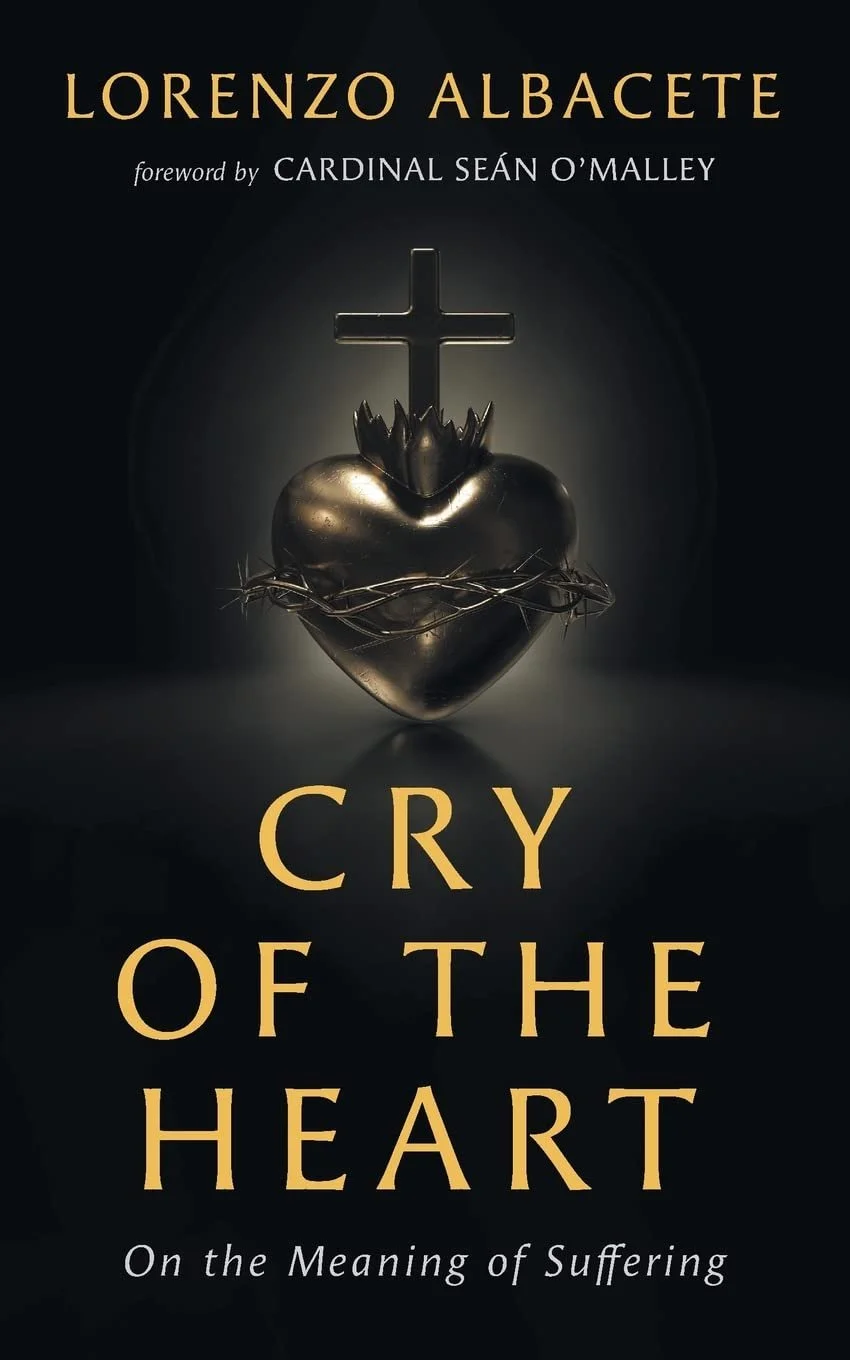
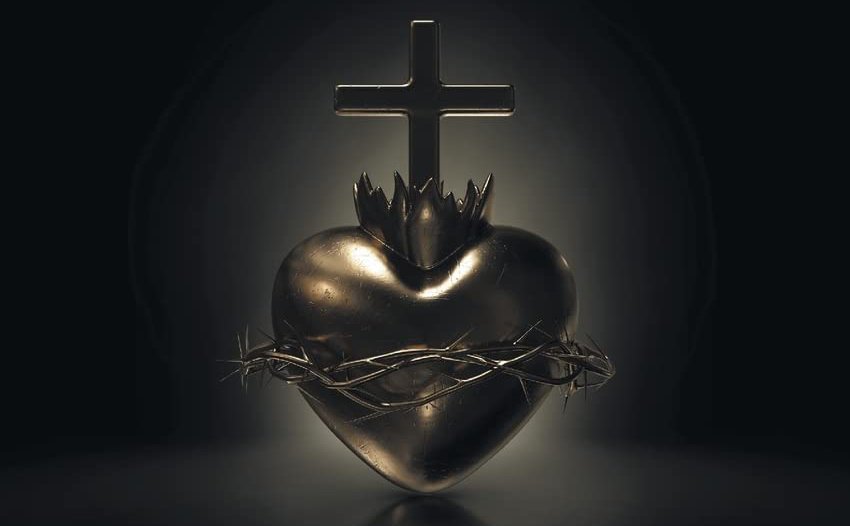
The cover art of the book is an important key to understanding the book. The modern image of the Sacred Heart of Jesus radiating light amidst the black background reveals the author’s main thesis: that the love of God revealed in Jesus Christ is the only answer to the darkness and mystery of suffering and death. The title of the book, “Cry of the Heart” points first to the cry and thirst in Jesus’ heart to restore communion between God and humanity.
The book itself is divided into two parts. The first part recounts the author’s reflections on suffering. One notable aspect of this part is how he develops his work in dialogue with various authors of literary works (Walker Percy, Flannery O’Connor, Fyodor Dostoyevsky, Emmanuel Mounier, and Elie Wiesel, only to name a few). The final part is a short biography of his life written by John Touhey. In order to fully grasp the depth of his reflections, it is necessary to befriend Lorenzo and enter into the depth of his personal experience of suffering.
In this text, I will comment on a few important elements of this book to help us better understand and live the reality of human suffering. Every day we are thrown in front of the enigma of our own personal suffering and that suffering which seems to dominate every facet of reality. Often, we are dumbfounded at how to live the experience of suffering when it hits close to home. The hope is that these reflections will shine light on our experience of suffering and help us live them and find meaning in this dramatic experience.
In my work as a Catholic priest these reflections have been a great help to live the reality of suffering that I encounter every day. The content of these pages has been a light to help me live my weekly visits to the hospital, the jail, and the homebound, as well as my encounters with the homeless when I go to share a meal with them once a month. They invite me to let myself be completely defined by the light of God’s redeeming love.
CRY OF THE HEART. To properly understand the reality of suffering one must begin by looking at man’s experience. The human person is characterized by the cry for meaning that resides in the depths of his heart (p. 34). In every heart, there’s a type of divine restlessness (p. 8). When a person experiences suffering their heart cries out to God for salvation. For this reason, authentic suffering has a prophetic nature since it is orientated beyond itself and points to the transcendent nature of the human person (p. 36). It opens man up to God and to others.
The experience of suffering reveals that it is a type of dialogue or questioning of God (p. 42). One is moved to ask God: Who am I in the light of this drama? Why is this happening to me? The heart cries out for an explanation. If this cry were suffocated or eliminated entirely, we would risk abolishing the dialogue with God and completely abolish man’s search and questioning for meaning. When the human person goes beyond the material world for an answer to his suffering, he enters into dialogue with others and with God.
SECULARIZATION OF SUFFERING. Fr. Albacete describes the common way of seeing the reality of suffering as having a deeply mistaken approach (p. 21). It is reduced to a technical problem to be solved and not a mystery to be lived. This is a great error of our times. It cannot accept the challenge of suffering (p. 40). It attempts to eliminate its relationship with the person of Christ and man’s openness to transcendence (p. 44). As a consequence, the human person is reduced to a mere object that can easily be manipulated (p. 41). Suffering becomes a disfigurement to be removed at all costs (p. 27). These reductive views inevitably lead one to see the reality of suffering as an argument against the existence of God.
“TENDERNESS LEADS TO GAS CHAMBER” (The Thanatos Syndrome, Walker Percy). There is a clash taking place today between two competing approaches to suffering: “tenderness” versus redemptive suffering (p. 22). Fr. Albacete draws from this quote to show how today’s rejection of God and Christ has led to the reality of suffering being detached from its logical root. The reality of suffering is now just like a fragile leaf blowing in the wind. The author quotes the firsthand experience of the Holocaust survivor Elie Wiesel to illustrate this affirmation. When this divorce takes place, all that is left in front of the reality of suffering is mere theory, and this impulse leads to the gas chamber (p. 27).
In front of this void, the concept of “quality of life” has been raised to the highest good in our world. This has brought along with it a culture and mindset where those people who are suffering and who have a diminished “quality of life” are expendable, and the only solution to their suffering is to put them to death (p. 27). When we separate tenderness from Christ it becomes evil.
REDEMPTION BY CO-SUFFERING. The redemption of suffering is the only response that does not deny its reality or extinguish some critical aspects of the human heart (p. 37). For Christians, the problem of suffering is inseparable from the Cross (p. 1). Jesus’ death on the Cross reveals the magnitude of the problem behind the mystery of suffering (p. 55). There is a common tendency today to believe that Jesus’ death is a mere judicial payment of a debt that humanity could never have ever paid (p. 56). This is a terrible reduction. Jesus died on the Cross so that through His death God could redeem all suffering. In this event, Jesus fully enters the world of suffering and death to completely co-suffer with us and to restore our true identity before God (p. 58). Through the total embrace of these mysteries, the Son fully identifies with our wounded human condition while at the same time restoring our filial identity that was present from the very beginning (p. 55). For Christians, true human dignity is rooted in our sharing in the identity of the eternal Son of the living God (p. 57). His death thus transformed the drama of suffering into a drama of love and showed how divine mercy is more powerful than sin and death (p. 19).
The reality of suffering can be relieved by the co-sufferer only when the co-sufferer can bring the suffering person into contact with grace and into the experience of being loved. The only authentic answer to suffering is always an experience of love and companionship (p. 7).
THE MISSION OF THE CHURCH. The Church has the responsibility and mission to go to the world of suffering and to co-suffer with all those who are suffering, and in this way to co-suffer with Christ who is present in all who suffer. As friends and disciples of Jesus, we are called to learn how to imitate Him who came into the world to suffer with us. Only in this total imitation of Christ, by co-suffering with other people do we stake our complete identity on the Cross with everyone we meet.
As followers of Christ, we have a vocation and a mission to join the community of “redemptive suffering” and help support everyone we encounter who is suffering. St. Paul beautifully describes this divine call: “Now I rejoice in suffering for your sake, in my flesh I complete what is lacking in Christ’s afflictions for the sake of His Body that is the Church” (Colossians 1:24). The only adequate Christian response to suffering must be to walk along with the sufferer towards God, to become totally involved with the sufferer in their questioning and searching for meaning (p. 42). In this way co-suffering implies a type of co-praying which he describes as a willingness to accompany and support the sufferer’s dialogue with God (p. 43). The experience of being accompanied by a co-sufferer is a privileged vehicle through which the sufferer is continuously reminded of his true identity before God. This is the authentic experience of love through which Christians are called to change the world.
As we continue to marvel at the beauty of autumn and as we begin the month of November, which is traditionally dedicated to the praying for the dead, I would like to invite everyone to read this beautiful meditative book. Journeying with Fr. Albacete through the many diverse elements that make up the reality and mystery of suffering, one is greatly helped to live the drama of this experience in the light of God’s redemptive mercy.
