
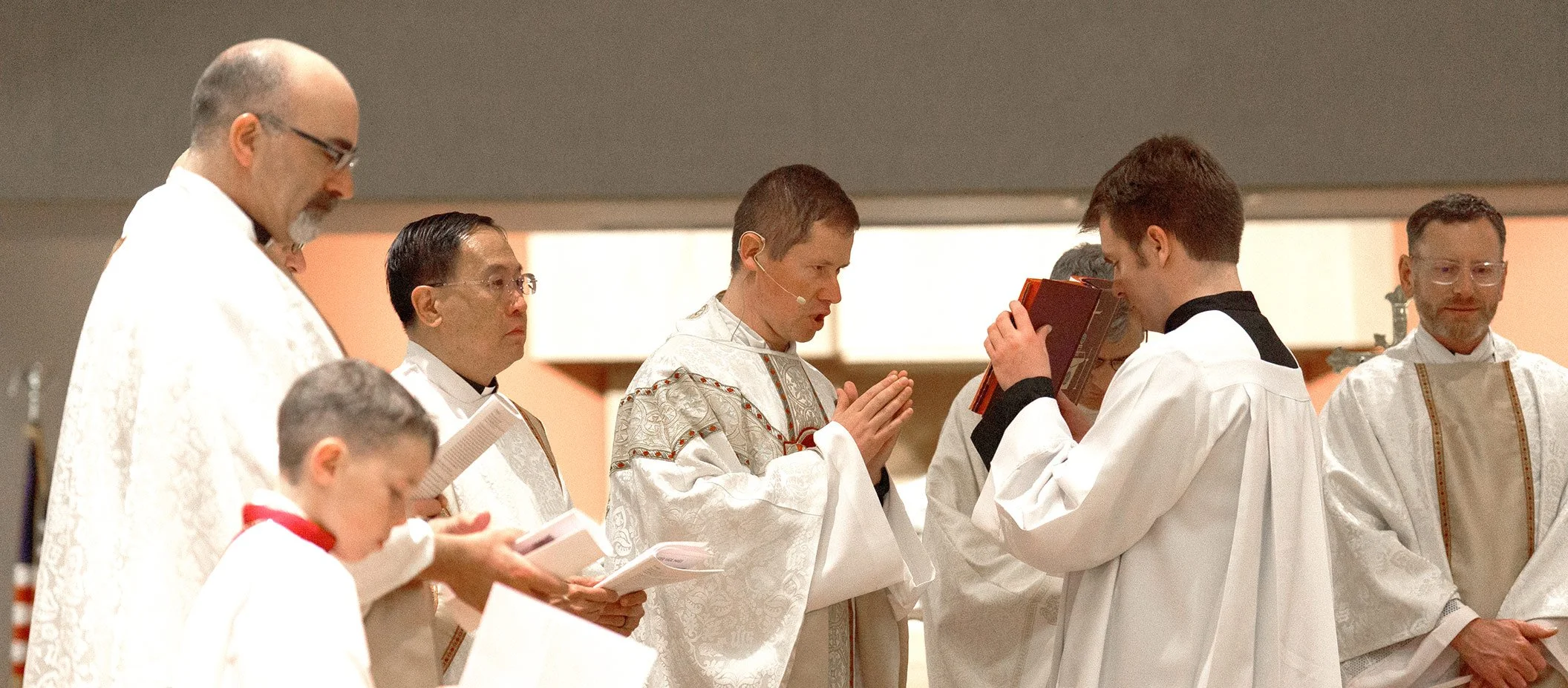
“In the words of the liturgy, the truth of God and of redeemed man is meant to blaze.”
(Romano Guardini, Meditations Before Mass)
By Fr. John Roderick, F.S.C.B.
March, 2026
Have you ever been struck by the words of a prayer at Mass? Have you ever heard a phrase or expression that took you by surprise and remained with you throughout the week? In a book on the Mass that I am currently reading, Meditations Before Mass by Romano Guardini, a 20th Century German theologian, he writes that “in the words of the liturgy, the truth of God and of redeemed man is meant to blaze” (p. 10). Earlier this year, I had such an experience of the words of the liturgy setting my heart ablaze, and I wanted to share this experience with you in this meditation.
It happened in the weeks after Christmas, while I was celebrating Mass in the rectory chapel. Although much of the Eucharistic liturgy remains the same throughout the liturgical year, certain prayers of the Mass change depending on the liturgical season. These prayers are commonly known as the Collect Prayer, Prayer over the Offerings, and Prayer after Communion. These are incredibly beautiful prayers and, as they are unique to the changing seasons, can have the power to surprise and move us.
The prayer that caught my attention on this day was the Prayer after Communion. After receiving Holy Communion and a period of silent prayer, the priest calls everyone to prayer before the final blessing. He says, “Let us pray.” After a silent pause in which the faithful recollect themselves and place their personal intentions before God, the priest recites the Prayer after Communion, uniting his prayer with all the prayers of the faithful.
Most times, the Prayer after Communion has two parts: 1) an invitation to remember the gift received in the Eucharist, and 2) a petition that the gift of the Eucharist accompany the faithful and that it bear fruit in the lives of the faithful as they return to everyday life and go out to attend their personal responsibilities. At this moment, before the end of the Mass, I can sometimes be a little distracted and am already thinking of where I must go or what I must do immediately after Mass. Often, I fail to perceive the richness of this prayer.
Here is the text of the prayer that particularly struck me.
"O God, who touch us through our partaking of your Sacrament, work, we pray, the effects of its power in our hearts, that we may be made fit to receive your gift through this very gift itself. Through Christ our Lord." (Roman Missal)
When I first recited this prayer, it seemed like God was inviting me to stop and reflect on the incredible mystery I was celebrating. As we were in the post-Christmas season, I felt as if God was saying to me, “Hey, Fr. John, the mystery of Christmas just took place again, the Word became flesh in the bread being transubstantiated into the Body of Christ, and I want you to welcome the Christ child into your life just like Mary and Joseph did years ago.”
I would like to share with you in this short reflection how I was moved and my heart set ablaze by this prayer of the Church. Normally, I would not have given this prayer too much consideration, but the prayer returned two more times in the liturgy that week, and something struck me. It seemed like God wanted me to reflect upon it and share what this experience has generated in me.
The mystery of a God who touches us through the Eucharist. I was deeply moved by the verb touch. One hears an echo of the beginning of the First Letter of John, which is read throughout the Christmas season, “What was from the beginning, what we have heard, what we have seen with our eyes, what we looked upon and touched with our hands concerns the Word of life—for the life was made visible” (1 John 1:1-2). In the liturgy, God desires to step into time, to reach out and touch us, and offer His whole self to us through the Sacrament of the Eucharist. In light of this experience, I could not stop thinking about how generous God is in revealing and communicating Himself through the celebration of the sacraments.
Your sacrament. The sacraments we celebrate are not our own but are God’s sacraments. We receive from God the possibility to celebrate His sacraments. Jesus Himself is mediated to us through the sacraments. While reflecting on this beautiful prayer, I came across a teaching by St. Leo the Great on the sacraments. He wrote, “From the very beginning the Church has grasped, enlightened by the Holy Spirit, that that which was visible in Jesus, that which could be seen with the eyes and touched with the hands, His words and His gestures, the concreteness of the incarnate Word—everything of Him had passed into the celebration of the sacraments” (Catechism of the Catholic Church, No. 1115, as cited in Desiderio Desideravi, On the Liturgical Formation of the People of God, Francis, 2022, No. 9). These words really moved me. The whole life of Jesus and everything we know of Him is recapitulated and made present in the celebration of the sacraments.
I found an echo of this intuition on Jesus being communicated to us in the Eucharist in the book on the Mass I mentioned above by Guardini, which I would also like to share with you. He wrote, “It is not by accident that the essential part of the Mass is preceded by the Epistle and Gospel, for each of the sacred texts is a clue to Christ’s identity, is some facet of His personality or truth, some event in His life that comes forward to be understood and accepted; each is a ray of that Truth which will be present at the Consecration no longer in word but in His real existence” (p. 179). Guardini’s insight linking the Liturgy of the Word and the Liturgy of the Eucharist helps us see the unity of the Mass. The truth of Christ and His companions narrated in the Liturgy of the Word are rays of the Truth that become flesh, become real and present in time and space, through the prayers of the Eucharistic Consecration.
Work, we pray, the power of its effects in our hearts. Another element that caught my attention was the verb work. In reciting the prayer at the end of Mass, I was asking God to do a work on my heart, to convert it and fill it with His love. God takes the initiative in our lives and desires to work in us. In the celebration of the sacraments, the Father is like a Divine Potter, molding, shaping, and healing His beloved children’s hearts. These words call to mind the words of the Prophet Ezekiel, “I will sprinkle water upon you to cleanse you from all your impurities, and from all your idols I will cleanse you. I will give you a new heart and place a new spirit within you, taking from your bodies your stony hearts and giving you natural hearts” (36:25-26). In this season of Lent, where we are focused on our own efforts to unite our sacrifices with the Sacrifice of Jesus, it might be helpful to remember that God Himself is at work in us. He is always the main protagonist of our personal conversion and invites us to collaborate in this work. He desires our healing and purification. Our efforts join with His work that has already begun in us.
That we be made fit. The prayer goes on to say that through our participation in the sacraments, we are made fit. What does it mean that we are to be made fit? Fit for what? That we are to be made fit to receive the gift of Jesus Christ. In the Gospels, we see Jesus desiring to make His followers “fit” to be united to Him. The words that Jesus addressed to Simon Peter at the beginning of the Last Supper are helpful on this point and are particularly relevant in this Lenten season where we are approaching the Holy Thursday liturgy in a few short weeks, “Unless I wash you, you will have no inheritance with me” (John 13:8). Jesus desires to wash the feet of His disciples to make them fit to share eternal life with Him. At first, seeing Jesus kneel and take a towel and a wash bowl in His hands, Simon Peter is confused and embarrassed. He knows very well how dirty his feet are. Then Simon Peter adamantly refuses that Jesus will perform such a humble gesture, usually reserved for the servants of the house. However, Jesus insists and invites him to convert his way of looking at the situation. Jesus desires to help Simon encounter more deeply His love, so that he too can share in it. Simon Peter finally yields to Jesus’ gaze of mercy and allows Him to wash his feet.
What might this mean for us? Jesus has a burning desire to place Himself before us in the position of a servant to embrace and wash our sinful condition. He desires to make us fit to share life with Him.
To receive your gift. When we participate in the sacraments, we can live a remarkably similar experience to that of Simon Peter in the Last Supper. We are both confused about Jesus, the Son of God, wanting to touch and embrace our sinful hearts, and embarrassed about how dirty they really are, the many sins, distractions, and failures to love that dwell there. We resist welcoming His gaze of mercy into our lives and fill our hearts and minds with distractions. The liturgy invites us to place ourselves at the school of Simon Peter and ask for the grace to continuously yield to Jesus’ gaze of mercy, to allow Him to touch our hearts. In this way, we become fit to receive Jesus, the greatest gift that God can give us.
In the liturgy, God is speaking to us and desires to set our hearts ablaze and to draw us more intimately into a relationship with Him; Father, Son, and Holy Spirit. During this great Lenten season, let us pray together that we may receive the grace to overcome our many distractions during the Mass or our inattentive participation in the liturgy that can happen over time. We are made to actively welcome God’s healing touch in our hearts through the celebration of the sacraments. May the truth of God and of redeemed man communicated through the liturgy truly set us all ablaze this Lenten season.
